
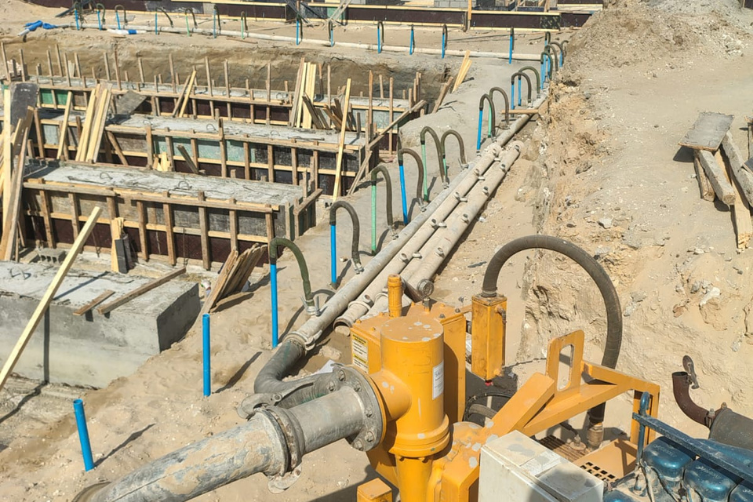
Deep well dewatering systems, underground water control, and soil water management for Saudi Arabia's trillion-dollar construction boom.
Saudi Arabia’s Vision 2030 has ignited one of the world’s largest construction surges with over 5,200 active projects valued at USD 819 billion. Managing groundwater on these sites is critical. From deep well dewatering systems in Riyadh’s metro corridors to soil water control along NEOM’s Red Sea coastline, dewatering pumps in Saudi Arabia have become the backbone of safe, efficient, and code-compliant construction. This guide covers everything engineers, contractors, and project managers need to know.
- $1.27BSaudi Arabia Water Pumps Market Size (2024)
- 5.2%CAGR of KSA water pumps market (2024–2030)
- 5,200+Active construction projects in Saudi Arabia (2024)
- $819BTotal value of Saudi construction pipeline (2024)
Why Dewatering Pumps Are Critical in Saudi Arabia’s Construction Sector
Saudi Arabia sits atop extensive aquifer systems including the vast non-renewable Saq and Wajid aquifers that intersect countless major infrastructure corridors. When excavation for deep foundations, metro tunnels, basements, or below-grade infrastructure penetrates the water table, construction cannot proceed safely without robust dewatering pumps and groundwater control systems.
The demand for dewatering systems in construction in Saudi Arabia has never been higher. The Kingdom’s construction market was valued at USD 70.33 billion in 2024 and is projected to reach USD 91.36 billion by 2029. Megaprojects like NEOM, the Riyadh Metro (USD 22.5 billion), Jeddah’s metro, and the Red Sea Project all require multi-stage groundwater management systems to keep excavations dry, safe, and structurally sound.
‘At NEOM’s The Line, approximately 500 dewatering wells were drilled along coastal sections alone making it one of the world’s largest active dewatering operations in construction history.’
In coastal areas such as Jeddah, Yanbu, and the NEOM development zone near the Gulf of Aqaba, saline groundwater poses an additional threat: corrosion of reinforcement steel and premature degradation of concrete. This makes underground water control in Saudi Arabia not just a convenience but a structural and safety imperative.
Types of Dewatering Systems Used in Saudi Arabia Construction
Selecting the right dewatering system depends on soil permeability, excavation depth, groundwater salinity, and project scale. Below is a comparison of the key systems deployed across Saudi construction sites:
| System Type | Depth Range | Best Soil Type | Key KSA Application | Typical Pump Used |
|---|---|---|---|---|
| Open Sump Pumping | 0–3 m | Gravels, coarse sands | Shallow trenches, footings | Centrifugal surface pump |
| Wellpoint System | 3–7 m | Fine to medium sands | Road works, pipelines, shallow basements | Vacuum-assisted centrifugal |
| Deep Well Dewatering System | 7–50+ m | Gravels, fractured rock, mixed strata | Metro tunnels, deep foundations, NEOM | Submersible borehole pump |
| Electro-Osmosis | 0–5 m | Silts, clays | Sensitive historic sites, old Jeddah | DC-powered electrode arrays |
| Vacuum Deep Wells | 5–20 m | Fine sands, silts | Coastal reclamation zones | Vacuum + submersible combo |
| Eductor / Ejector Wells | 20–50 m | Fine to medium sands | Deep basements, Riyadh KAFD district | High-pressure jet pump |
Source: Engineering best-practice references; compiled from KSA project data
Deep Well Dewatering System in Saudi Arabia: How It Works
A deep well dewatering system in Saudi Arabia is the most widely applied method for large-scale, deep excavations. The system works by drilling a series of boreholes typically 300mm to 600mm in diameter to depths below the planned excavation base, then installing a submersible pump in each well to continuously lower the surrounding water table.
Key Components of a Deep Well Dewatering System
Each deep well installation consists of a perforated PVC or stainless-steel casing lined with geotextile filter fabric, a high-capacity submersible borehole pump (typically 4′ to 12′ diameter), a riser column pipe, a surface discharge header connecting all wells, and a settlement/monitoring pond for environmental compliance. In Saudi Arabia’s coastal zones where saline groundwater is common all metallic components must be corrosion-resistant, typically using 316-grade stainless steel.
Well spacing is determined by geotechnical assessment (permeability test / pumping test). In typical KSA sandy gravels, wells are spaced 15–30 metres apart. In lower-permeability coastal silts, spacing narrows to 5–10 metres with vacuum assistance added.
Case Study: NEOM's The Line - World-Scale Dewatering in Action
Case Study
NEOM’s The Line – Deep Well Dewatering Along the Gulf of Aqaba Coast
Project: The Line, NEOM – northwestern Saudi Arabia
Challenge: Excavating a 2.4 km initial phase of a 170 km trench through sandy coastal terrain with high-volume saline groundwater intrusion at depths of 10–40 metres.
Dewatering Solution: Deep well dewatering system with approximately 500 borehole wells drilled along coastal construction sections.
Outcome: The dewatering system continuously removed saline groundwater from excavated zones, directing it to monitored settlement ponds before controlled discharge. This protected reinforcement steel from corrosion and allowed foundation piling including 101.1-metre-deep test piles to proceed safely. The system represented one of the most ambitious applications of underground water control in Saudi Arabia’s construction history, and set new benchmarks for deep well dewatering engineering in the Middle East.
Sources: Zee News Engineering Report, Dec 2025; POWERCHINA NEOM milestone report, Feb 2024; Wikipedia — The Line construction data.
Soil Water Control in Saudi Arabia: Engineering Challenges
Effective soil water control in Saudi Arabia must account for the Kingdom’s unique geological and climatic conditions. Unlike temperate construction environments, KSA sites face:
1. Extreme thermal cycles: Summer temperatures exceeding 45°C accelerate pump seal degradation and require heat-rated motors (Class F or H insulation) with continuous duty ratings.
2. Dual aquifer layers: Many Riyadh and Eastern Province sites encounter both a shallow perched aquifer and a deeper confined aquifer requiring staged dewatering strategies with independently controlled pump zones.
3. High sand content: KSA soils often contain fine aeolian sands that can rapidly choke pump impellers. Sand separators and slow-start VFD (variable frequency drive) controllers are standard practice on well-designed KSA dewatering installations.
4. Regulatory compliance: Saudi Aramco Engineering Standards (SAES) and the Saudi Building Code (SBC 303) specify dewatering monitoring protocols, including piezometer networks, daily water-level logging, and environmental discharge permits for saline effluent.
Saudi Arabia Dewatering Market: Key Data at a Glance
| Indicator | Value | Year / Period | Source |
|---|---|---|---|
| Saudi Arabia water pumps market size | USD 1,269.8 million | 2024 | PS Market Research |
| Projected market size (KSA) | USD 1,719.7 million | 2030 | PS Market Research |
| CAGR – KSA water pumps | 5.2% | 2024–2030 | PS Market Research |
| MEA dewatering pump market (global) | USD 7.95 billion | 2022 | Cognitive Market Research |
| Global dewatering pump CAGR | 6.2% | 2023–2030 | Cognitive Market Research |
| Saudi industrial pump market value | USD 880 million | 2024 | Ken Research |
| Saudi construction market value | USD 70.33 billion | 2024 | Expert Market Research |
| Al-Riyadh province pump market share | 29% (largest) | 2024 | PS Market Research |
Sources: PS Market Research, Cognitive Market Research, Ken Research, Expert Market Research – 2024/2025 reports.
Underground Water Control in Saudi Arabia: Best Practices
Effective underground water control in Saudi Arabia requires a systematic approach from pre-tender geotechnical assessment through to construction completion and aquifer recovery monitoring. Industry-leading contractors follow this proven sequence:
Phase 1 – Site Investigation
Conduct a pumping test (constant-rate test and step-drawdown test) to determine hydraulic conductivity, specific yield, and radius of influence. In KSA, the Saudi Standards SASO 1522 governs borehole construction standards. Piezometers must be installed at minimum three locations around each major excavation zone.
Phase 2 – System Design
Use geotechnical modelling software (e.g., MODFLOW, GMS, or SEEP/W) to model cone of depression, estimate required pump flow rates (typically 2–50 L/s per well in KSA sandy gravels), and confirm the number and spacing of wells needed to achieve the target drawdown usually 0.5 to 1.0 metres below formation level.
Phase 3 – Installation & Operation
Wells are rotary-drilled and developed by air-surging before pump installation. Submersible pumps are connected to a surface monitoring and control panel with automatic float switches, flow meters, and remote SCADA telemetry increasingly standard on Saudi Vision 2030 megaprojects for real-time oversight.
Phase 4 – Monitoring & Shutdown
Daily water level logs, pump flow rates, and discharge water quality (especially salinity and turbidity) are recorded throughout the dewatering period. Shutdown is staged gradually to avoid sudden pore pressure changes that could cause heave or piping in adjacent structures.
Conclusion: The Future of Dewatering Systems in Saudi Arabia
As Saudi Arabia accelerates its Vision 2030 infrastructure agenda with a USD 91.36 billion construction market by 2029 and more than 5,200 active projects underway the role of advanced dewatering pumps and groundwater management systems has never been more strategically important.
The next generation of dewatering systems in Saudi Arabia will integrate SCADA-based remote monitoring, solar-powered pump stations for off-grid desert sites, AI-driven predictive maintenance, and real-time aquifer modelling to balance construction efficiency with environmental sustainability. Projects like NEOM are already setting new global benchmarks for deep well dewatering system scale and precision.
Whether you are a contractor procuring dewatering pumps in Saudi Arabia, an engineer designing a deep well dewatering system for a metro corridor, or a project manager seeking reliable soil water control and underground water control for a KSA giga-project, understanding the local geology, regulatory environment, and pump technology landscape is the foundation of successful groundwater management.
Frequently Asked Questions
Dewatering pumps are high-capacity pumps used to remove groundwater from excavation zones, trenches, and construction sites to keep the working area dry and structurally stable. In Saudi Arabia, they are essential because many urban and coastal areas particularly Riyadh, Jeddah, Dammam, and NEOM have shallow water tables that intersect with deep foundations, metro tunnels, and basement structures. Without dewatering, excavations risk flooding, structural collapse, and damage to adjacent buildings. The Saudi water pumps market is valued at USD 1.27 billion (2024) and growing at 5.2% CAGR through 2030, largely driven by Vision 2030’s construction surge.
A deep well dewatering system is a network of boreholes typically 7 to 50+ metres deep each fitted with a submersible pump to lower the groundwater table across a large excavation area. In Saudi Arabia, it is the preferred method for metro tunnel construction, NEOM foundation works, high-rise basement excavations in Riyadh’s KAFD district, and coastal infrastructure where shallow wellpoints cannot achieve the required drawdown. Each deep well pump continuously removes groundwater, creating a cone of depression that keeps the excavation dry. The NEOM project alone deployed approximately 500 deep dewatering wells along its coastal construction zones.
A wellpoint system uses closely-spaced shallow rods (typically 1–2 m apart) driven to depths of 3–7 metres, connected by a common header pipe to a single surface vacuum pump. It is ideal for roads, pipelines, and shallow basements. A deep well dewatering system uses individually drilled boreholes (15–30 m apart) to depths of 7–50+ metres, each with its own submersible pump. Deep wells suit large excavations, metro tunnels, and deep foundations in Saudi Arabia where wellpoints cannot achieve the required depth of drawdown. Cost-wise, wellpoints are cheaper to install but limited in depth; deep wells are more expensive but far more effective for complex KSA projects.
Soil water control in Saudi Arabia must address the extreme climate (45°C+ summer heat), dual aquifer layers (shallow perched and deep confined), fine aeolian sands that clog pump impellers, and saline coastal groundwater. Best practices include using heat-rated motor classes (F or H insulation), VFD (variable frequency drive) soft-start controllers to minimise sand surging, geotextile filter sock on well screens, SCADA telemetry for real-time monitoring, and piezometer networks at 3+ locations per excavation zone. Saudi Aramco Engineering Standards (SAES) and the Saudi Building Code (SBC 303) govern dewatering compliance requirements.
Al-Riyadh Province holds the largest share of Saudi Arabia’s water pump market at 29% (2024), driven by massive construction activity in and around Riyadh including the USD 22.5 billion metro project, KAFD high-rise developments, and Qiddiya. The Eastern Province is second due to oil & gas operations and industrial hubs. Jeddah and the NEOM/Tabuk region are fastest-growing demand zones due to coastal mega-projects and the Red Sea tourism development. Demand is also rising in Al-Madinah following a 4+ billion SAR water transmission project serving Hajj infrastructure.
Centrifugal pumps dominate the Saudi Arabia construction dewatering market, holding a 70% market share in 2024. Submersible borehole pumps (4″–12″ diameter) are standard for deep well systems. Vacuum-assisted centrifugal pumps are used for wellpoint systems. For saline coastal environments, 316-grade stainless steel submersibles are required. Leading pump brands active in KSA include Grundfos, Xylem (Flygt), KSB, Sulzer, Flowserve, and regional supplier Al Samhan Factory for Saudi Pumps. Positive displacement pumps are growing fastest (2024–2030) for high-pressure and slurry dewatering applications in mining and oil & gas adjacent construction zones.