
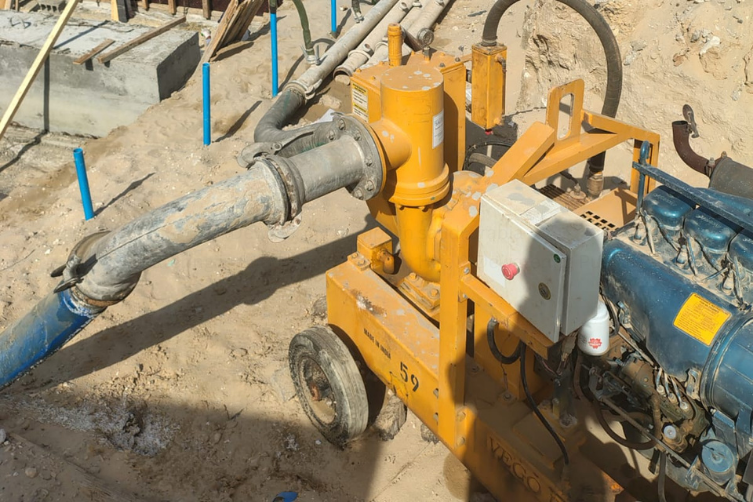
Groundwater Is the Silent Threat No Saudi Contractor Should Ignore
You’ve finalised the design. The permits are approved. Equipment is on-site and the team is ready. Then the first excavator bucket breaks ground and water starts rising.
It happens faster than most people expect. Groundwater doesn’t announce itself. It seeps in through soil layers, pressurises from coastal aquifers, or surges after an unexpected rainfall event. Within hours, what was a clean, dry excavation pit becomes a muddy, dangerous liability.
This is the reality facing construction teams across Saudi Arabia every day from Riyadh’s urban mega-projects to petrochemical expansions in Jubail, coastal developments in Jeddah, and the unprecedented scale of NEOM. And the number one mistake contractors make? They don’t engage a qualified dewatering supplier in Saudi Arabia before the digging starts.
This guide explains exactly how groundwater destroys construction projects, what it costs when things go wrong, and how professional ground water control in Saudi Arabia keeps your site safe, your timeline intact, and your budget under control.
How Groundwater Actually Destroys Construction Projects
Understanding the mechanism of groundwater damage is the first step toward preventing it. Here are the five ways water wins when contractors aren’t prepared.
1. Trench and Excavation Wall Collapse
When saturated soil loses its shear strength, excavation walls become unstable. Sandy and silty soils common across much of Saudi Arabia are particularly vulnerable. A trench that looked solid yesterday can collapse without warning after overnight water infiltration.
Trench collapses are not just expensive. They are fatal. According to international construction safety data, excavation collapses are among the leading causes of construction fatalities worldwide, and water infiltration is a primary trigger.
2. Foundation Failure and Differential Settlement
Concrete poured into a wet or waterlogged base produces a weakened, contaminated mix. Over time, foundations laid in poor conditions crack, tilt, and settle unevenly sometimes years after the building is occupied. Addressing foundation failure post-construction can cost ten to twenty times more than proper underground water control in Saudi Arabia at the excavation stage.
3. Flooded Excavation Pits
A flooded pit doesn’t just pause work, it reverses it. All excavated material becomes a slurry that must be removed again. Dewatering a flooded pit takes far longer and costs significantly more than preventive systems. In the GCC summer heat, stagnant water in pits also creates health hazards for workers.
4. Equipment Damage and Downtime
Heavy machinery excavators, compactors, cranes suffer serious mechanical damage in waterlogged conditions. Mud ingestion destroys engines, wet electrical systems fail, and tracks sink in saturated ground. Equipment downtime from water damage routinely runs into hundreds of thousands of Saudi riyals on large sites.
5. Project Delays and Penalty Clauses
Most commercial construction contracts in Saudi Arabia include liquidated damages clauses for late delivery. A single week lost to groundwater flooding can trigger penalty clauses that wipe out project margins entirely. This is the financial reality that makes investing in dewatering pumps in Saudi Arabia one of the highest-return decisions on any build.
The Saudi Arabia Groundwater Reality: What Makes It Different
Ground water control in Saudi Arabia is more complex than in many other construction markets. Several regional factors make groundwater management a specialised discipline here:
Regional Factor | Impact on Construction |
High coastal aquifer pressure (Jeddah, Dammam, Eastern Province) | Rapid water rise during excavation, even at shallow depths |
Loose sandy and silty soil profiles | High permeability water infiltrates quickly and destabilises easily |
Sabkha (salt flat) zones in Eastern Province | Extremely corrosive and unstable when saturated |
Industrial and petrochemical zones in Jubail and Yanbu | Pressurised groundwater with potential chemical contamination |
Wadi flood zones in Western Region | Flash flooding risk during rainfall events |
Vision 2030 deep excavation megaprojects | Unprecedented groundwater management challenges at scale |
Sources: Saudi Geological Survey, Royal Commission for Jubail and Yanbu, Construction Industry Institute
This is why choosing a dewatering supplier in Saudi Arabia with genuine local geological knowledge is not a preference, it is a project-critical requirement.
The Real Cost of Getting Dewatering Wrong
Let’s put numbers to what groundwater damage actually looks like on a Saudi construction budget:
- Flooded pit re-excavation: SAR 150,000–500,000+ depending on pit volume and equipment needed
- Foundation repair due to poor water control: SAR 500,000–2,000,000+ for mid-scale projects
- Equipment downtime and repair: SAR 50,000–300,000 per major equipment failure
- Liquidated damages for project delays: Typically 0.1%–0.5% of contract value per day
- Worker injury liability: Costs that no project budget can adequately absorb
Compare those numbers to the cost of hiring qualified dewatering pump suppliers in Saudi Arabia from the beginning. In almost every case, preventive dewatering costs a fraction of the damage it prevents.
How Professional Dewatering Stops Groundwater From Winning
The solution is systematic, engineered ground water control not just throwing a pump into a flooded pit. Here’s what a professional approach looks like:
Step 1: Geotechnical Assessment
Before any dewatering system is designed, a qualified supplier reviews your site’s geotechnical investigation report. They assess soil permeability, groundwater depth, seasonal water table variation, and proximity to aquifer recharge zones. This assessment determines which dewatering method is appropriate.
Step 2: System Design and Installation
Based on the assessment, the right system is designed and installed before excavation begins. The most common systems offered by dewatering pump companies in Saudi Arabia include:
Wellpoint Dewatering A row of small suction pipes installed around the excavation perimeter, connected to a central vacuum pump. Effective for depths up to 6 metres. Ideal for pipeline trenching, shallow basement construction, and road projects in sandy soils.
Deep Well Dewatering Large-diameter bored wells fitted with high-capacity submersible pumps. Used for excavations deeper than 6 metres high-rise foundations, industrial plants, tunnels, and major infrastructure projects. This is the dominant method for Vision 2030 megaproject excavations.
Sump Pump Systems A reactive method that collects water entering the excavation into a sump and pumps it out continuously. Used as a supplement to primary systems or for minor water ingress management.
Eductor Systems High-pressure jet-driven systems for low-permeability silts and clays where vacuum-based systems are less effective. Used in specific geological conditions found in parts of the Western Region and reclaimed coastal land.
Step 3: Continuous Monitoring and Operation
A professional dewatering system doesn’t just run, it’s monitored. Water level sensors, flow meters, and regular site inspections ensure the system maintains the designed drawdown level throughout the excavation and foundation phases. This is where dewatering pump companies in Saudi Arabia earn their value: not just in equipment, but in expertise and ongoing management.
Dewatering Pump Rental vs. Purchase: The Smart Choice for Saudi Contractors
One of the most common questions contractors ask is whether to rent or buy dewatering pumps in Saudi Arabia. Here’s the direct answer for most scenarios:
Rent. Unless you’re running continuous dewatering operations across multiple sites simultaneously for years at a time, rental through established dewatering pump suppliers in Saudi Arabia delivers better financial and operational outcomes.
Decision Factor | Rental | Purchase |
Capital outlay | Minimal | High (SAR 50K–500K+ per unit) |
Maintenance and servicing | Supplier’s responsibility | Your responsibility |
Emergency backup units | Usually provided | Self-arranged |
Access to latest equipment | Yes | Only if you upgrade |
Flexibility to scale up/down | High | Limited |
Storage and logistics | Supplier managed | Your cost |
Best suited for | Project-based contractors | Fleet operators |
Emergency situations, a sudden flood, an unexpected aquifer breach also favour having a rental relationship with a supplier who can deploy additional pumps within hours. That 24/7 emergency response capability is one of the most important criteria when selecting dewatering pump suppliers in Saudi Arabia.
What to Look for in a Dewatering Supplier in Saudi Arabia
Not all suppliers are equal. These are the non-negotiables:
- Proven local experience – Can they explain Saudi-specific geological challenges? Have they worked in Jubail, NEOM, or coastal Jeddah?
- Full system capability – Do they offer wellpoint, deep well, sump, and eductor options, or only one method?
- Modern, well-maintained equipment – Ask about average fleet age and maintenance schedules
- 24/7 emergency response – Groundwater emergencies don’t keep office hours
- Discharge compliance support – Reputable suppliers help you navigate KSA regulations on water discharge
- Kingdom-wide deployment – Projects across Riyadh, Jeddah, Dammam, Jubail, and NEOM require logistics capability, not just local presence
- Technical consultation – The best suppliers advise you before you sign a contract, not just after you call with a flooded pit
Industries That Cannot Afford to Skip Ground Water Control in Saudi Arabia
Dewatering is not only a construction issue. The demand for dewatering pumps in Saudi Arabia spans almost every major industrial sector:
- Commercial and residential construction – foundations, underground parking, basements
- Oil and gas – pipeline corridors, refinery expansions, offshore support infrastructure
- Petrochemical plants – Jubail and Yanbu industrial city expansions
- Road and highway projects – underpasses, culverts, bridge pile foundations
- Municipal infrastructure – sewage network upgrades, water treatment facilities
- Marine and coastal – port expansion, seawall construction, jetties
- Tunnelling – Riyadh Metro extensions, road tunnels, utility corridors
- Mining – mineral extraction projects in the Hejaz Mountains region
Key Takeaways
- Groundwater is one of the top causes of construction project failure in Saudi Arabia through trench collapse, foundation damage, equipment loss, and schedule delays
- Ground water control in Saudi Arabia requires local geological expertise, not generic pumping solutions
- The five primary dewatering systems wellpoint, deep well, sump, eductor, and combined stage systems each suit different site conditions
- Preventive dewatering costs a fraction of reactive flood management or structural repair
- Dewatering pump rental in Saudi Arabia is the right choice for the vast majority of project-based contractors
- When selecting a dewatering supplier in Saudi Arabia, prioritise local experience, full system capability, emergency response, and discharge compliance support
- Vision 2030 is driving unprecedented demand for qualified dewatering pump companies in Saudi Arabia engage your supplier early
Conclusion
Groundwater doesn’t care about your project schedule, your contract penalty clauses, or your safety record. It will find every weakness in an unprepared excavation site and exploit it. But with the right dewatering supplier in Saudi Arabia engaged from the planning stage, it becomes a manageable engineering challenge rather than a project-ending crisis.
The smartest contractors in Saudi Arabia don’t treat dewatering as a line item to cut, they treat it as the foundation beneath the foundation. From deep well systems for NEOM’s massive excavations to wellpoint arrays for Riyadh pipeline networks, professional ground water control in Saudi Arabia is what separates projects that deliver on time from those that don’t deliver at all.
Before you dig your first metre, make sure groundwater is already solved. Because once the water is in the pit, you’re not just fighting water, you’re fighting time, cost, and gravity all at once.
Frequently Added Questions
Excavation removes soil that was previously containing natural groundwater pressure. Once that barrier is broken, water flows toward the lower-pressure zone, your excavation pit. In Saudi Arabia, coastal aquifers and high-permeability sandy soils make this happen faster and more aggressively than in many other countries.
Deploy sump pumps immediately to reduce standing water, then call a professional dewatering supplier in Saudi Arabia to assess and install a proper wellpoint or deep well system. Temporary sump pumping buys time but does not address the underlying groundwater pressure.
Ideally at the geotechnical investigation stage before excavation is even planned. A good supplier will review your site investigation report and help design the dewatering approach as part of your excavation methodology, not as a reactive measure.
Concrete mixed with or poured into groundwater experiences dilution of the cement-to-water ratio, leading to reduced compressive strength. It can also cause segregation of aggregates and washing out of cement paste. The result is a structurally compromised foundation that may not be visible for years.
Yes, established dewatering pump companies in Saudi Arabia have the fleet capacity, technical expertise, and Kingdom-wide logistics to support gigaproject-scale operations. Multi-stage deep well systems, combined with telemetric monitoring, are used for excavations at NEOM and similar megaproject scales.
Dewatering groundwater must be discharged in compliance with local municipality requirements and, in industrial zones, Royal Commission for Jubail and Yanbu (RCJY) or NEOM Authority guidelines. Discharge to municipal drains typically requires pre-approval. Contaminated groundwater requires treatment before discharge. A reputable dewatering supplier in Saudi Arabia will guide you through the correct process.
Duration varies significantly. Shallow pipeline projects may only need dewatering for two to four weeks. Deep foundation projects for high-rise buildings may require continuous dewatering for twelve to twenty-four months. Systems typically operate until the structure is watertight and permanent drainage is in place.
Yes. Industrial dewatering pumps used by reputable suppliers in Saudi Arabia are rated for continuous operation in extreme ambient temperatures. Regular maintenance checks on motor cooling systems and seal integrity are essential during summer months.
Sabkha is salt-flat terrain found extensively in Saudi Arabia’s Eastern Province. It consists of highly saline, corrosive, and often waterlogged ground that behaves unpredictably during excavation. Dewatering in sabkha zones requires corrosion-resistant pump components and more intensive monitoring than standard soil conditions.
Yes, wherever road projects involve underpasses, culverts, bridge pile foundations, or utility crossings below the water table. Wellpoint dewatering is commonly used for linear road excavations. Given Saudi Arabia’s expanding highway and metro network under Vision 2030, demand for road construction dewatering services is at an all-time high.