
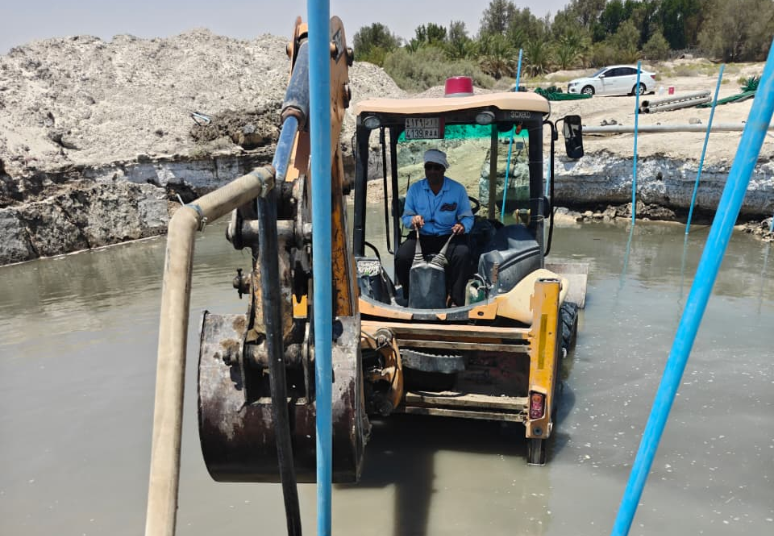
Anyone typing “dewatering pump on rent near me” into Google right now is doing so against the backdrop of a construction equipment rental market that’s expanding fast and a climate pattern that’s making groundwater control more urgent, not less. Here’s what the current numbers actually show, plus a look at how rental dewatering plays out on real project types across the Kingdom.
The Market by the Numbers
Estimates vary by research firm depending on methodology and scope, but the direction is consistent: Saudi Arabia’s construction equipment rental sector, which includes dewatering pumps alongside excavators, generators, and earthmoving machinery is growing at a healthy clip, driven heavily by Vision 2030 project execution.
| Source | 2025 Market Value | Forecast Value | CAGR | Forecast Period |
| IMARC Group | USD 1.3 billion IMARC | USD 2.3 billion by 2034 IMARC | 6.34% IMARC | 2026–2034 |
| Report Cube | USD 2.30 billion Global Risk Community | USD 5.51 billion by 2034 Global Risk Community | 10.20% Global Risk Community | 2026–2034 |
| Vyansa Intelligence | USD 415 million Vyansa Intelligence | USD 925 million by 2032 Vyansa Intelligence | 12.13% Vyansa Intelligence | 2026–2032 |
| TechSci Research | USD 2.1 billion (2024) | USD 3.7 billion by 2030 TechSci Research | 9.56% TechSci Research | 2026–2030 |
| Grand View Research | USD 1,182.0 million (2023) Grand View Research | USD 1,818.3 million by 2030 Grand View Research | 6.6% Grand View Research | 2025–2030 |
The spread between estimates reflects differing scope (some include only heavy earthmoving gear, others fold in gensets, cranes, and specialty equipment like pumps), but every single forecast points the same direction: up, and meaningfully so.
A few data points worth pulling out:
- Earthmoving equipment holds roughly 65% of rental market share in Saudi Arabia, with roads and highway projects accounting for about 35% of demand both categories where dewatering is frequently a prerequisite before work can even begin. Vyansa IntelligenceVyansa Intelligence
- More than 10 companies currently serve the construction equipment rental space, with the top 5 holding around 30% of market share meaning it’s still a fragmented market with room for specialized, responsive local players rather than a few giants controlling everything. Vyansa Intelligence
- GASTAT data from January 2026 shows rental costs for equipment used in residential construction rose 1.9% year-over-year, driven mainly by a 2.4% increase in equipment-and-operator rental costs a signal that demand for fully supported rentals (not just bare equipment) is climbing. Vyansa Intelligence
- The FY 2026 Budget allocated SAR 35 billion to the Transportation and Infrastructure Sector, and that kind of spending typically flows through phased, multi-stage projects exactly the project structure that favors renting equipment over buying it outright. Vyansa Intelligence
- Mega-projects like NEOM and Red Sea Global are cited directly as accelerators of heavy construction machinery demand, and a notable February 2026 development was GFH’s majority-stake acquisition of Byrne Equipment Rental, a company with a fleet described at roughly 16,000 units and a depot network including a flagship Jubail operations hub relevant context for anyone in the Eastern Province specifically. The Report CubeThe Report Cube
Why Climate Patterns Are Making This More Urgent
This isn’t just an infrastructure-spending story, it’s increasingly a weather story too. Research on the Arabian Peninsula notes that rapid urbanization combined with poor drainage has made Saudi Arabia increasingly prone to flash floods, with Riyadh, Jeddah, and Makkah affected with growing frequency. Climate modeling adds weight to this, under high-emission scenarios, extreme precipitation event intensity in parts of the Arabian Peninsula is projected to increase by roughly 34% under a moderate-emissions pathway and by about 48% under a high-emissions pathway, relative to 20th-century baselines.
This shows up in real events, not just models. Jeddah recorded 179 mm of rain in a single severe flash-flooding event in November 2022, and civil defense authorities issued thunderstorm and flash-flood warnings covering Riyadh, Jeddah, Al-Baha, Asir, and Jazan as recently as 2025, with a separate December 2025 advisory covering Riyadh, Qassim, Hail, Madinah, Makkah, Al-Baha, Asir, Jazan, and parts of the Eastern Province. For contractors, this translates directly into unplanned groundwater intrusion on sites that weren’t designed around it, exactly the scenario where having a rental supplier on speed-dial, rather than owned equipment sitting idle most of the year, pays off. FloodList + 2
What This Looks Like on Real Project Types
Rather than abstract benefits, here’s how dewatering rental needs typically break down by sector, based on how the market is actually segmented:
Infrastructure and roadworks. With roads and highways representing roughly a third of rental demand and earthmoving equipment dominating fleet composition, dewatering pumps get deployed heavily during subgrade preparation particularly on projects crossing wadis or low-lying terrain, where water table issues only become apparent once excavation starts. A typical pattern: a contractor budgets for a 2–3 week dewatering window, but unexpected inflow (especially after a rain event) pushes that to 5–6 weeks. Renting rather than owning means that extension is a cost adjustment, not a capital problem.
Urban basement and utility work. In dense cities like Jeddah and Riyadh, submersible pumps tend to be the equipment of choice: compact footprint, fast deployment, suited to confined excavation pits where a larger diesel rig simply won’t fit. These projects are also the ones most exposed to the flash-flood risk patterns described above, since urban drainage infrastructure in older districts wasn’t built for the rainfall intensities now being recorded.
Industrial and oil & gas maintenance. Temporary water removal during turnaround and maintenance windows is typically short-duration but high-stakes, any delay in getting a pump on site translates directly into lost production time. This is the segment where supplier proximity (a depot within the Eastern Province, for instance) matters most, since mobilization speed often outweighs unit pricing in the supplier-selection decision.
How a Project Typically Plays Out
To make this concrete, here’s a generalized walk-through reflecting how dewatering rental decisions commonly unfold on Saudi construction sites, not a specific client account, but a composite of the pattern described above.
Scenario: Mid-size road infrastructure project, Eastern Province. Excavation for a culvert crossing hits unexpected groundwater at roughly 2.5 meters, well before the contractor’s dewatering plan accounted for it. Soil stability around the pit starts to degrade within hours of standing water accumulating. A diesel-driven trash pump is mobilized from a local depot within the same day, paired with a smaller submersible unit for fine dewatering near the trench edges. The combined setup runs continuously for about three weeks until the pour is complete and backfill begins. The key variable here isn’t the pump’s flow rate, it’s how fast the equipment reached the site, since every hour of standing water increases the risk of pit collapse.
Scenario: Urban basement excavation, Jeddah. A residential tower foundation hits a perched water table during the rainy season, compounded by runoff from an unrelated storm event two days into excavation. With limited site access for large machinery, the contractor opts for two compact submersible units rather than a single high-capacity diesel pump, prioritizing maneuverability in a tight urban lot over raw pumping volume. Given Jeddah’s documented flash-flood exposure, the supplier also keeps a standby unit on 24-hour call for the duration of the rainy period, a flexibility arrangement that would be far harder to justify with owned equipment sitting unused most of the year.
These patterns repeat across the Kingdom’s active project pipeline, and they illustrate the core logic behind renting, the right equipment, matched to site conditions, available fast enough that groundwater doesn’t become the thing that decides your schedule.
What to Take Away From the Data
Three things stand out when you put the market numbers and the climate data side by side. First, demand for rental dewatering equipment is structurally growing, not just cyclically, it’s tied to a multi-year infrastructure spending program, not a temporary construction boom. Second, the market remains fragmented enough that supplier responsiveness and local depot proximity are real differentiators, not just equipment specs on paper. Third, the weather variable is becoming less predictable, which means the contractors with a rental relationship already in place rather than scrambling to find one mid-flood-warning are the ones who keep projects on schedule.
If you’re searching for a dewatering pump on rent near you in Saudi Arabia, the practical takeaway from all of this is: prioritize a supplier who can mobilize fast, has the right equipment type for your site conditions (diesel, electric, or submersible), and offers flexible terms that match how unpredictable groundwater conditions actually are not just how the project plan assumed they’d be. Read our latest blogs for more information.
Frequently Added Questions
Rental costs depend on pump type, capacity, and rental duration, with diesel units typically costing more per day than electric or submersible pumps. Most suppliers offer daily, weekly, and monthly packages, with per-day rates dropping significantly on longer-term contracts. Contact a local supplier directly for project-specific pricing.
Pump size depends on excavation depth, groundwater inflow rate, and soil type, not project size alone. A site assessment by the rental supplier is the most reliable way to match pumping capacity to actual water volume, since underestimating capacity is one of the most common dewatering mistakes.
Timelines vary widely, some sites clear in a few days, while sites with high groundwater inflow or clay-heavy soil can require continuous pumping for several weeks. Unexpected rainfall or perched water tables can extend timelines beyond the original estimate, which is why flexible rental terms matter.
A dewatering pump is built for high-volume, continuous removal of groundwater from large excavation areas, trenches, or tunnels, while a sump pump handles smaller, localized water collection points, typically in basements or pits. Construction sites generally require dewatering-grade equipment for sustained, heavy-duty use.
Discharge requirements depend on the municipality and discharge location (storm drain, wadi, or treatment facility), so contractors should confirm local environmental and water authority regulations before starting pump operations. A reputable supplier can usually advise on compliant discharge practices for the project area.
Diesel pumps are preferred for remote sites or locations without stable power access, due to their portability and higher pumping capacity. Electric pumps suit urban sites with grid access where lower noise and emissions are priorities. The right choice depends on power availability and site location, not preference alone.
Yes, removing groundwater reduces hydrostatic pressure and soil saturation around an excavation, which is one of the primary causes of pit wall instability and collapse. Proper dewatering, combined with shoring where needed, is a standard part of excavation safety planning on Saudi construction sites.
Delivery speed depends on supplier proximity and current fleet availability, with local suppliers typically able to mobilize equipment within the same day for urgent needs. This is one of the main reasons contractors prioritize suppliers with depots near their project site rather than national chains based farther away.
For most construction projects, renting is more cost-effective than buying, since it avoids large upfront equipment costs, ongoing maintenance expenses, and storage between projects. Buying typically only makes financial sense for companies running dewatering equipment continuously across multiple long-term projects.
Common failure causes include incorrect pump sizing for the water volume, debris clogging intake screens, fuel or power supply interruptions, and lack of routine maintenance. Choosing a rental supplier that includes technical support and backup equipment availability helps minimize downtime if a failure occurs.