
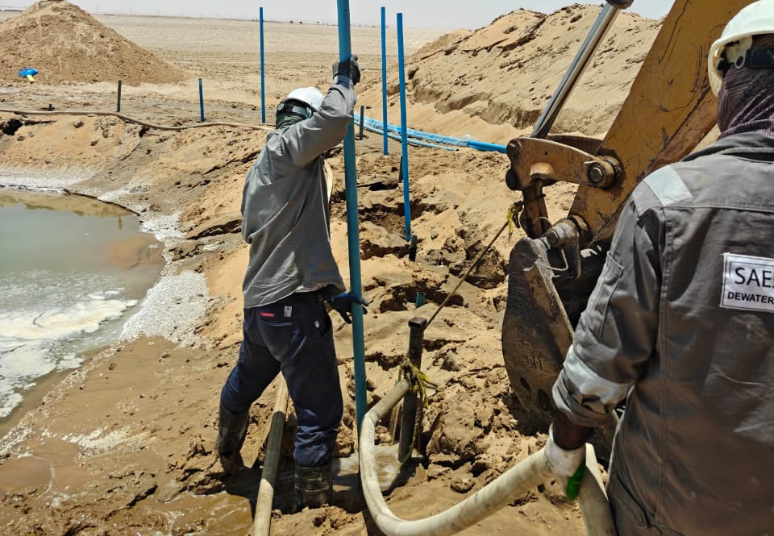
There’s no single “best” dewatering method, there’s only the best method for your site. The right choice depends on soil permeability, excavation depth, how much water you’re dealing with, how long the job will run, and what you’re allowed to discharge under local regulations.
This guide answers the 25 questions contractors, site engineers, and project managers ask most often when deciding how to keep a Saudi Arabia excavation dry from simple sump pumping to deep well systems for major infrastructure work.
Quick Comparison: The Four Main Dewatering Methods
| Method | Typical Depth / Drawdown | Best Soil Type | Relative Cost | Best For |
| Sump Pumping | Shallow excavations; removes water already in the pit rather than lowering the water table | Permeable soils – sand, gravel | Lowest | Short jobs, minor seepage, surface/rainwater removal |
| Wellpoint System | Roughly 5–6 metres (about 15–18 ft) drawdown per stage; multiple stages for deeper cuts | Works across most soil types, especially sandy soils | Low–moderate | Shallow-to-medium trenches, foundations, pipeline work |
| Deep Well System | Can exceed wellpoint depth significantly; uses submersible pumps in individual drilled wells (typically 150–200 mm diameter) | High-permeability soils | Highest | Large excavations, high-volume discharge, long-duration projects |
| Eductor (Ejector) Well System | Can lower the water table by 100+ ft from the top of excavation | Low-permeability soils – silts, clays | High | Deep excavations where wellpoints can’t generate enough suction |
Comparative figures are drawn from widely cited construction dewatering engineering references (2023–2026) and are typical industry ranges that always confirm exact drawdown and flow requirements with a site-specific hydrogeological assessment.
Section 1: The Basics
1. What is dewatering?
Dewatering is the process of removing groundwater or surface water from a site, usually a construction excavation so that digging, foundation work, or tunnelling can proceed in dry, stable conditions below the natural water table.
2. Why is dewatering necessary on a construction site?
Standing or rising water in an excavation increases the risk of soil erosion, slope instability, and pit collapse. It also delays work, raises costs, and can create unsafe conditions for workers and equipment.
3. What is the best dewatering method overall?
There isn’t one universal best method sump pumping is the cheapest and simplest for shallow, permeable soils, wellpoints suit medium-depth excavations in most soil types, deep wells handle large volumes in high-permeability ground, and eductor systems are the go-to for deep excavations in clay or silt. The best method is the one matched to your soil, depth, and water volume.
4. What factors determine the right dewatering method?
The main factors are: soil permeability, the depth to which the water table must be lowered, total water volume, project duration, proximity to existing structures, and local environmental or discharge regulations.
5. How long does dewatering typically take to set up?
Sump pumping can be running within hours. Wellpoint systems typically take a day or two to install and prime. Deep well and eductor systems, which require drilling, generally take longer to mobilize, often several days depending on the number of wells needed.
Section 2: Sump Pumping
6. What is sump pumping?
Sump pumping is the simplest dewatering method: a pit (sump) is dug at the lowest point of the excavation, water is allowed to flow into it by gravity, and a pump removes it as it collects, usually triggered automatically by a float valve.
7. When should I use sump pumping instead of a wellpoint system?
Use sump pumping when the excavation is shallow, the soil is permeable (sand or gravel), and you’re mainly dealing with surface water or minor seepage rather than a high-volume groundwater problem.
8. What’s the main limitation of sump pumping?
It doesn’t lower the water table around the excavation’ it only removes water that has already entered the pit. In sandy soils with high inflow rates, sump pumping alone often can’t keep up.
9. Is sump pumping the cheapest dewatering method?
Yes. It uses the simplest equipment and requires minimal specialized expertise, making it the most cost-effective option when site conditions allow for it.
Section 3: Wellpoint Dewatering
10. What is a wellpoint dewatering system?
A wellpoint system uses a series of small-diameter wells placed in a ring or line around the excavation, each connected to a riser pipe and a shared header pipe, which is pumped by a vacuum-assisted wellpoint pump.
11. How deep can a wellpoint system lower the water table?
A single stage of wellpoints typically achieves a drawdown of around 5–6 metres (roughly 15–18 feet) below the pump level, since the system works on a suction principle. Deeper excavations require multiple staged wellpoint installations.
12. What soil types work best with wellpoint dewatering?
Wellpoint systems are versatile and can work in most soil types, though they’re especially effective in sandy soils.
13. Is wellpoint dewatering suitable for foundation work?
Yes, wellpoint systems are commonly used for building foundations, shallow-to-medium trenches, and utility excavations where a moderate, controlled drawdown is needed.
14. What happens if my excavation goes deeper than one wellpoint stage can handle?
Additional wellpoint stages are installed progressively deeper as the excavation advances, each stage lowering the water table further in sequence.
Section 4: Deep Well Systems
15. What is a deep well dewatering system?
A deep well system uses an array of individually drilled wells (typically 150–200 mm in diameter), each fitted with a submersible pump. Pumping from each well creates a “cone of depression,” and multiple wells acting together lower the groundwater level over a wide area.
16. When is deep well dewatering the right choice?
Deep well systems are best for large excavations, high-volume discharge requirements, and long-duration projects particularly in high-permeability soils where wellpoints alone wouldn’t achieve sufficient drawdown.
17. Why is deep well dewatering more expensive than other methods?
It requires drilling rigs, more powerful submersible pumps, individual electrical connections for each well, and longer installation timelines all of which add cost compared to sump pumping or wellpoints.
18. Can deep well systems achieve a larger drawdown than wellpoints?
Yes. Because deep wells don’t rely on suction the way wellpoints do, they can achieve much larger drawdowns, limited mainly by well depth and site hydrogeology rather than pump suction limits.
Section 5: Eductor (Ejector) Well Systems
19. What is an eductor well dewatering system?
An eductor (or ejector) system pumps high-pressure water down one pipe inside a well, which creates suction that draws groundwater up through a second pipe, a method used specifically where wellpoints can’t generate enough suction and standard drilling isn’t practical.
20. When would I choose an eductor system over a wellpoint or deep well system?
Eductor systems are the preferred choice for deep excavations in fine-grained, low-permeability soils like silts and clays, where wellpoints struggle and where the excavation is too deep for simple sump pumping.
21. How much can an eductor system lower the water table?
Eductor systems can lower the water table by more than 100 feet (around 30 metres) from the top of the excavation significantly deeper than a single wellpoint stage.
Section 6: Choosing, Pricing & Practical Considerations
22. How does soil permeability affect my choice of dewatering method?
High-permeability soils (sand, gravel) generally suit deep well or wellpoint systems, since water moves through them quickly and needs to be actively drawn down. Low-permeability soils (silts, clays) are better handled by eductor systems, since standard suction-based methods can’t extract water fast enough.
23. What determines dewatering pump hire pricing?
Pricing depends on pump type (submersible, centrifugal, self-priming), flow rate and head requirements, hire duration, fuel type, whether the groundwater carries solids, and delivery distance to your site. A site-specific quote is always more accurate than a generic rate card.
24. Do I need a permit for construction dewatering?
In most cases, yes, especially if discharged water may contain pollutants or sediment. Regulations vary by project location, so check local environmental and municipal requirements before discharging pumped groundwater.
25. How do I choose a reliable dewatering company for my project?
Look for a supplier that assesses your specific soil and excavation conditions before recommending equipment, stocks a full range of pumps (submersible, centrifugal, solids-handling), can mobilize quickly, and offers 24/7 support for the duration of the job since dewatering systems often need to run continuously for weeks at a time.
Final Word: Matching the Method to the Site
The “best” dewatering method is really a match-making exercise between four variables: soil type, depth, water volume, and project duration. Get any one of those wrong and you either overpay for equipment you didn’t need, or underpower a site that keeps flooding back.
If you’re unsure which method fits your excavation, sump pumping, wellpoint, deep well, or eductor the safest move is a site assessment before equipment is mobilized, not after water has already started rising.
Need expert advice or dewatering pump hire in Saudi Arabia?
Saeedcon’s engineering team assesses site and soil conditions before specifying equipment, supporting construction, mining, and infrastructure projects across Riyadh, Jeddah, Dammam, Al Khobar, and Jubail get in touch for a same-day site consultation.