
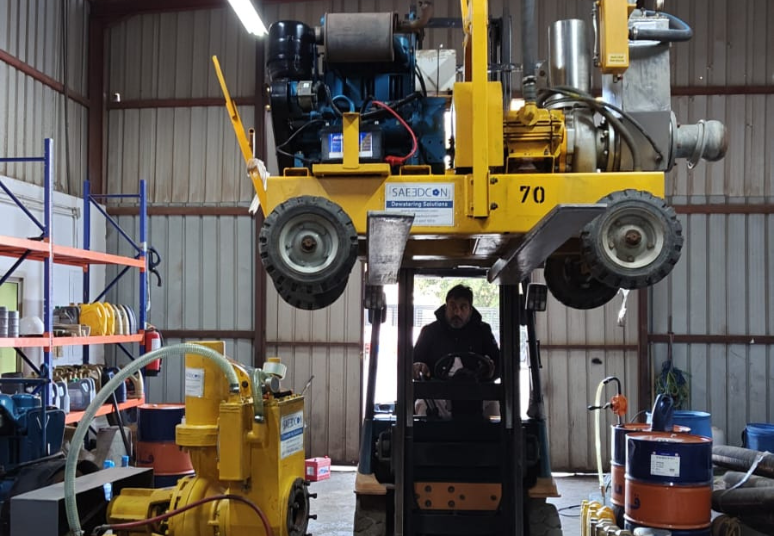
How to Calculate the Right Dewatering Pump Capacity for Your Site
Selecting the correct pump capacity is one of the most important decisions in Ground Water Control in Saudi Arabia. An undersized pump causes flooding, delays, and increased construction costs, while an oversized pump wastes fuel, electricity, and equipment rental expenses.
Whether you’re constructing a commercial tower in Riyadh, an industrial facility in Jubail, an infrastructure project in NEOM, or an oil & gas installation in the Eastern Province, accurately calculating dewatering pump capacity ensures efficient groundwater removal and uninterrupted construction progress.
This guide explains the engineering principles behind pump sizing, provides real-world calculation methods, includes practical case studies, and highlights how experienced dewatering pump suppliers in Saudi Arabia determine the best solution for every site.
Why Is Correct Pump Capacity Important?
An efficient dewatering system provides:
- Stable excavation conditions
- Dry working environment
- Reduced soil instability
- Lower equipment downtime
- Better project safety
- Lower operating costs
- Compliance with construction specifications
For projects involving Ground Water Control in Saudi Arabia, groundwater conditions can vary dramatically due to coastal areas, sandy soils, reclaimed land, and high water tables.
What Determines Dewatering Pump Capacity?
Pump capacity depends on several engineering factors.
| Site Parameter | Why It Matters |
| Excavation depth | Determines drawdown required |
| Groundwater level | Controls pumping volume |
| Soil permeability | Higher permeability = more inflow |
| Excavation size | Larger area collects more groundwater |
| Total Dynamic Head (TDH) | Determines pump pressure requirement |
| Pumping distance | Affects friction losses |
| Discharge elevation | Adds vertical head |
| Rainfall or recharge | Increases inflow during operation |
Professional dewatering pump companies in Saudi Arabia evaluate all of these before selecting equipment.
Step 1: Calculate Groundwater Inflow
The first step is estimating how much groundwater enters the excavation.
Groundwater inflow depends on:
- Soil permeability (k)
- Excavation dimensions
- Water table elevation
- Hydraulic gradient
Engineers often use Darcy’s Law for preliminary groundwater flow estimation:
Q = k × A × i
Where:
- Q = Flow rate
- k = Soil permeability
- A = Flow area
- i = Hydraulic gradient
More complex projects may require pumping tests and hydrogeological modelling rather than simplified calculations.
Step 2: Determine Total Dynamic Head (TDH)
The pump must overcome:
- Static lift
- Discharge elevation
- Pipe friction losses
- Valve losses
- Hose losses
Formula:
TDH = Static Head + Friction Loss + Discharge Head
Example:
| Component | Value |
| Water lift | 8 m |
| Discharge elevation | 4 m |
| Pipe friction | 3 m |
| Valve losses | 1 m |
| Total Dynamic Head | 16 m |
Step 3: Select Required Pump Flow
After estimating groundwater inflow, engineers normally add a safety margin.
Example:
Estimated groundwater inflow = 210 m³/hr
Recommended safety factor = 20%
Required Pump Capacity:
210 × 1.20
= 252 m³/hr
This prevents overflow during unexpected groundwater increases.
Real Data: Typical Pump Capacities
Typical construction dewatering pumps operate within the following flow ranges:
| Pump Size | Typical Flow Rate |
| 1.5 inch | 90–120 GPM |
| 2 inch | 90–300 GPM |
| 3 inch | 300–800 GPM |
| 4 inch | 400–1,300 GPM |
| 6 inch | 400–1,800 GPM |
Actual output varies depending on Total Dynamic Head and pump efficiency.
Example Calculation for a Saudi Construction Site
Project:
Industrial warehouse
Location:
Eastern Province
Excavation Depth:
6 meters
Groundwater Level:
1.5 meters below ground
Estimated inflow:
180 m³/hr
Pipeline Length:
90 meters
Static Lift:
7 meters
Friction Loss:
4 meters
Total Dynamic Head:
11 meters
Safety Factor:
25%
Final Pump Capacity:
180 × 1.25
= 225 m³/hr
Recommended system:
- Two duty pumps
- One standby pump
- Automatic level controls
- Backup generator
This configuration ensures continuous groundwater removal even during maintenance.
Case Study: Industrial Development in Jubail
Project
Industrial utility corridor
Challenge
Excavation extended below the groundwater table in sandy soil with continuous seepage.
Site Conditions
| Parameter | Value |
| Excavation Depth | 7.5 m |
| Water Table | 2 m |
| Soil Type | Fine Sand |
| Estimated Inflow | 420 m³/hr |
Solution
The contractor installed:
- Deep well dewatering system
- Three high-capacity diesel pumps
- Automatic monitoring system
- Standby emergency pump
Results
| Performance Metric | Outcome |
| Excavation remained dry | Yes |
| Construction delay | None |
| Fuel optimization | Improved by pump staging |
| Pump downtime | Minimal |
The project successfully maintained groundwater levels throughout excavation while minimizing operational interruptions.
Common Mistakes When Selecting Dewatering Pumps
Many contractors underestimate pump requirements.
Common errors include:
- Ignoring pipe friction losses
- Not accounting for seasonal groundwater rise
- Using pump flow only without head calculations
- No standby equipment
- Selecting pumps based only on pipe size
- Ignoring soil permeability
These mistakes frequently lead to flooding and project delays.
Which Dewatering System Is Best?
| Site Condition | Recommended System |
| Shallow excavation | Sump pumping |
| Sandy soil | Wellpoint system |
| Deep excavation | Deep well system |
| High inflow | Multiple deep wells |
| Rock excavation | Submersible pumps |
| Industrial projects | Diesel dewatering pumps |
Experienced dewatering pump suppliers in Saudi Arabia normally recommend systems after reviewing borehole reports and groundwater investigations.
How Saudi Arabia’s Climate Affects Pump Selection
Projects across Saudi Arabia experience unique groundwater challenges:
- Coastal regions often have shallow groundwater tables.
- Large infrastructure developments require continuous pumping.
- Desert sands have high permeability.
- Industrial zones frequently encounter groundwater recharge.
- High temperatures require reliable diesel-powered pumping systems.
These factors make proper pump sizing critical for successful Ground Water Control in Saudi Arabia.
When Should Contractors Use Multiple Pumps?
Instead of installing one oversized pump, engineers often recommend:
- Duty + standby configuration
- Variable frequency operation
- Pump staging
- Backup emergency pumping
Benefits include:
- Reduced fuel consumption
- Higher reliability
- Easier maintenance
- Lower failure risk
- Continuous operation
Conclusion
Choosing the correct pump capacity is essential for safe, efficient, and cost-effective Ground Water Control in Saudi Arabia. The process goes beyond selecting the largest available pump, it requires evaluating groundwater inflow, soil characteristics, Total Dynamic Head, excavation depth, and operational safety factors.
Partnering with experienced dewatering pump suppliers in Saudi Arabia ensures your project receives the right equipment, optimized fuel consumption, reliable backup systems, and expert technical support. Whether you’re working on industrial facilities, infrastructure, commercial developments, or large-scale construction, properly sized dewatering pumps Saudi Arabia can significantly reduce delays, improve safety, and keep your project on schedule.
Need Expert Dewatering Solutions?
Saeedcon Dewatering Solutions provides complete groundwater control services across Saudi Arabia, including deep well dewatering, wellpoint systems, pump rentals, diesel dewatering pumps, and turnkey groundwater management for construction, infrastructure, industrial, and oil & gas projects. Contact our team today for a site assessment and customized pump sizing recommendation.
Frequently Added Questions:
Most engineers add between 15% and 30%, depending on groundwater uncertainty and project risk.
Groundwater inflow and Total Dynamic Head (TDH) together determine the required pump capacity.
No. Large excavations often require multiple pumps, deep wells, or staged pumping systems.
Diesel pumps are preferred for remote construction sites without reliable electrical infrastructure, while electric pumps suit permanent installations with stable power supplies.
They assess borehole logs, soil permeability, groundwater levels, excavation geometry, pumping tests, Total Dynamic Head, and discharge requirements before recommending a pump.