
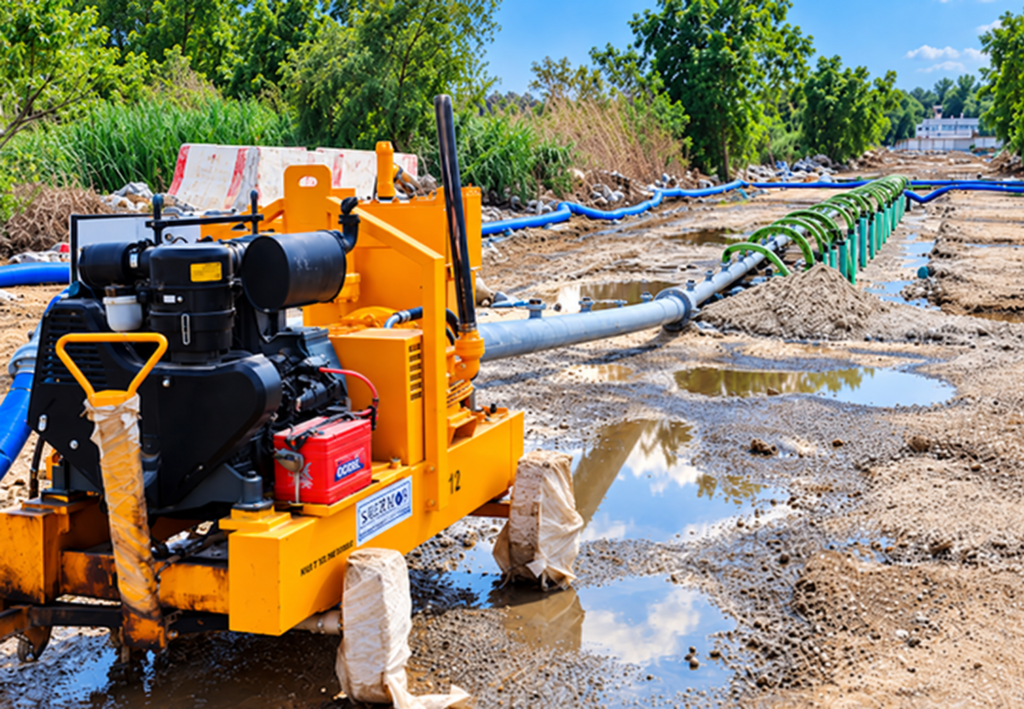
Choosing the wrong pump is one of the costliest mistakes on an excavation site. Your dewatering pump flow rate and head decide whether a trench stays dry or floods again by morning. At Saeedcon, we help contractors across Saudi Arabia size wellpoint, deep-well, and pump-based systems for construction, mining, and industrial projects. This guide explains both concepts in plain language and shows how to select the right capacity for Saudi site conditions.
What Is Dewatering Pump Flow Rate and Head?
Flow rate is the volume of water a pump moves over time. It is measured in cubic metres per hour (m³/h), litres per second (L/s), or gallons per minute (GPM).
Head is the height a pump can raise or push water, measured in metres. Think of it as the effort the pump must make. The two are linked: as head rises, flow falls. The pump curve shows exactly how.
Flow Rate vs. Head at a Glance
- Flow rate (Q): how much water you must remove.
- Total dynamic head (TDH): how hard the pump must work to remove it.
- Pump curve: the manufacturer’s graph of flow against head. Your duty point should sit near the pump’s best efficiency zone.
Why Pump Capacity Matters for Dewatering Solutions in Saudi Arabia
Demand for dewatering solutions in Saudi Arabia follows the construction pipeline. Projects planned or underway across the Kingdom reached $2.07 trillion in H1 2026, and construction output is forecast at about $190.4 billion in 2026, up from $179.4 billion in 2025.
Deep basements, metro lines, coastal developments, and utility trenches often sit close to high water tables. That makes accurate pump sizing a core part of soil water control in Saudi Arabia.
Saudi Construction Market Snapshot
| Indicator | Value |
| Construction output, 2025 | $179.4 billion |
| Construction output, 2026 (forecast) | $190.4 billion |
| Construction output, 2030 (forecast) | $250.2 billion |
| Planned or underway project value, H1 2026 | $2.07 trillion |
| Construction, industrial and transport contracts awarded, 2020 to Aug 2026 | ~$293.1 billion |
Source: Knight Frank, Saudi Arabia Construction Landscape Review (H1 2026), as reported by Zawya.
More excavation means more demand for dewatering pumps in Saudi Arabia, and more pressure to size them correctly the first time.
How to Calculate Dewatering Pump Flow Rate (Step by Step)
The right dewatering pump flow rate comes from three inputs: inflow, drawdown time, and a safety margin.
- Estimate groundwater inflow. Use soil permeability, excavation area, drawdown depth, and any tidal or seasonal influence. A geotechnical report supplies the inputs.
- Add surface water. Include rainfall runoff, washdown, and leakage from adjacent systems.
- Set the drawdown time. Draining a pit in 8 hours needs far more flow than draining it in 48.
- Add a safety margin. Most engineers add 20 to 30% for uncertainty and wear.
- Convert units. 1 L/s = 3.6 m³/h.
Typical Flow Rate Ranges by Application
| Application | Typical planning range (m³/h) |
| Small trench or manhole | 10 to 60 |
| Building basement excavation | 60 to 300 |
| Large foundation or shaft | 300 to 1,000+ |
| Wellpoint or deep-well systems | Sized per well, then multiplied |
Source: general engineering planning ranges, not site-specific. Always confirm with a hydrogeological assessment.
How to Calculate Total Dynamic Head (TDH)
TDH is the total resistance the pump must overcome:
TDH = static suction lift + static discharge height + friction losses + velocity and pressure head
The Four Head Components
- Static suction lift: the vertical distance from the water level to the pump.
- Static discharge head: the vertical distance from the pump to the outlet.
- Friction loss: energy lost in hoses, pipes, bends, and valves. Longer, narrower, or rougher lines lose more.
- Velocity and pressure head: energy needed to push water out at speed or into a pressurised line.
Pro tip: undersized discharge hose is the most common hidden cause of poor performance. A larger pipe diameter cuts friction loss sharply.
Pump Power and the Duty Point
Once you know flow (Q) and head (H), estimate the shaft power for water:
P (kW) = Q (m³/h) × H (m) ÷ (367 × efficiency)
Plot your Q and H on the manufacturer’s curve. The intersection is your duty point. Choose a pump whose best efficiency point is close to it. Running far left or right of that point wastes energy and shortens pump life.
Choosing the Right Dewatering Pump Type
- Submersible pumps: suited to deep pits, flooded sites, and quiet operation.
- Centrifugal pumps: versatile and easy to service at surface level.
- Self-priming pumps: reliable where suction conditions vary and the pump must restart without manual priming.
- Wellpoint and deep-well systems: for lowering groundwater across large areas rather than pumping from a single sump.
If your project is short-term, dewatering pump rental avoids the cost of owning equipment. For long-running work, buying often makes more sense. Both routes need the same flow and head calculation first.
Saeedcon Sizing Guide: How We Calculate a Basement Dewatering Pump
Illustrative example based on a standard sizing method. It is not a record of a specific client project.
When a contractor asks us for a pump, we start with the site, not the catalogue. For a typical commercial basement excavation of 50 m × 30 m with a 6 m drawdown, the process looks like this:
- Required flow: estimate 150 m³/h of inflow, add a 20% margin, and design for 180 m³/h.
- Static lift: 7 m.
- Friction loss: about 4 m over 150 m of discharge line.
- Discharge and velocity head: about 1 m.
- Total dynamic head: 7 + 4 + 1 = 12 m.
- Estimated shaft power at 55% efficiency: 180 × 12 ÷ (367 × 0.55) ≈ 10.7 kW.
Our recommendation: choose a pump, typically rated around 15 kW, whose curve passes through 180 m³/h at 12 m. Add a standby unit so work never stops during maintenance.
Lesson: design flow and head, not the motor size on the brochure, decide whether a pump is right.
Common Mistakes When Selecting Dewatering Pumps
- Choosing by horsepower alone instead of the pump curve.
- Ignoring friction losses in long discharge lines.
- Forgetting solids content, which clogs standard pumps.
- Skipping a standby pump on critical excavations.
- Overlooking high summer temperatures, which affect motor cooling and fuel use.
How to Choose Among Dewatering Pump Companies in Saudi Arabia
When comparing dewatering pump companies in Saudi Arabia, look beyond price. Check for:
- Engineering support for flow and head calculations before quoting
- Rental, sales, and full dewatering services from one supplier
- Experience with wellpoint, deep-well, and sump systems
- Round-the-clock service and maintenance
- Pump options for different site conditions
Saeedcon, based in Jubail, offers all of these under one roof. Our team asks about your soil, depth, and discharge route first, then recommends the right solution.
Key Takeaways
- Dewatering pump flow rate is how much water you move. Head is how hard the pump works.
- Always calculate total dynamic head, not just lift height.
- Add a 20 to 30% safety margin to estimated inflow.
- Select by the pump curve and duty point, not motor power alone.
- Match the pump type to solids content, depth, and power availability.
- Saudi Arabia’s growing construction pipeline makes proper soil water control essential.
Conclusion
Getting the dewatering pump flow rate and head right protects your schedule, budget, and site safety. Calculate inflow, work out total dynamic head, check the pump curve, and add a sensible margin. With Saudi Arabia’s construction pipeline still growing, a methodical approach to pump selection keeps excavations dry and projects on track.
Need help sizing a pump? Share your excavation size, water table depth, and discharge distance with the Saeedcon team. Call +966 53 603 9931 or request a quote.
Frequently Added Questions
What is dewatering pump flow rate?
It is the volume of water a pump removes per unit of time, usually in m³/h or L/s. It determines how quickly an excavation can be drained.
How do I calculate the flow rate for a dewatering pump?
Estimate groundwater inflow and surface water, choose a drawdown time, then add a 20 to 30% margin. Convert to m³/h or L/s as needed.
What is the difference between flow rate and head?
Flow rate is the quantity of water moved. Head is the height or pressure the pump must overcome. As head increases, flow decreases
What is total dynamic head in dewatering?
It is the sum of static lift, static discharge height, friction losses, and velocity or pressure head.
How do I choose the right dewatering pump size?
Calculate required flow and TDH, find that point on the pump curve, and choose a pump whose best efficiency zone is close to it.
Why does flow rate drop as head increases?
A centrifugal pump has a fixed energy output. Spending more of it lifting or pushing water leaves less to move volume.
Should I rent or buy a dewatering pump?
Rent for short projects or changing site conditions. Buy when you need long-term, repeated use. Either way, size the pump by flow and head first.
How much safety margin should I add to pump capacity?
Most engineers add 20 to 30%, plus a standby pump for critical excavations.
Can one pump handle a large excavation?
Rarely. Large sites usually combine several pumps, wellpoints, or deep wells with a standby unit.
What should I ask dewatering pump companies in Saudi Arabia?
Ask about engineering support, pump curves, rental and sales options, service response time, and similar project experience.