
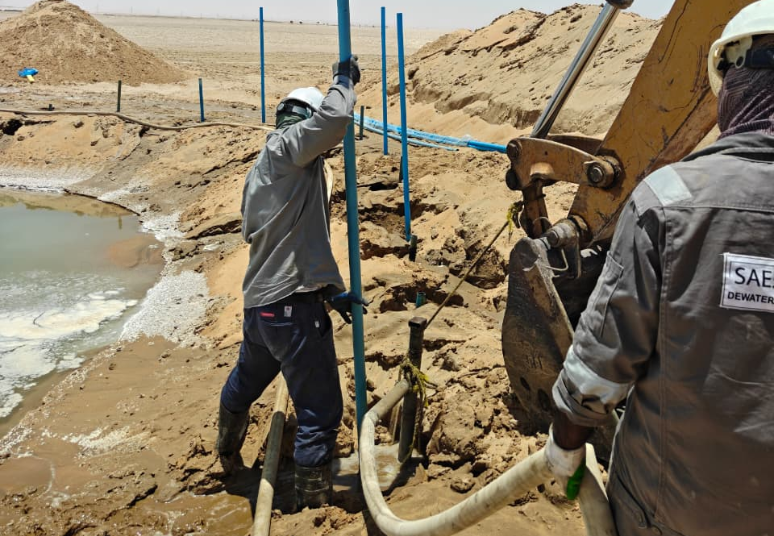
Dewatering in Jubail starts with understanding what is below the proposed excavation. Before equipment arrives, contractors need clear information about the soil, groundwater, surrounding structures and the route for removing pumped water.
A dry surface does not establish conditions at excavation depth. Whether the project involves foundations, a utility trench or industrial construction, groundwater control should be coordinated with the excavation and temporary works design.
When comparing dewatering companies in Jubail, ask how their proposal addresses the following seven checks.
What published local investigations tell us
A study published in Geomaterials, Engineering Geological Mapping of Al Jubail City, Kingdom of Saudi Arabia, reports investigations using 55 boreholes and 23 surface sampling points. Its groundwater mapping describes depths of approximately 2 metres near the coast, increasing to more than 5 metres inland in the mapped area. It also identifies variation between sabkha, dune sands and artificial fill.
These are published regional findings. They do not establish the current groundwater level, soil profile or pumping requirement at a particular construction plot.
For contractors, the practical implication is to obtain current measurements and a geotechnical interpretation for the actual excavation.
1. Review the soil investigation and excavation drawings
Start with the geotechnical report, borehole locations, laboratory results and current excavation drawings. Confirm the planned formation level, excavation dimensions, construction sequence and proposed ground support.
Ask the project engineer to identify which layers could affect water movement, excavation stability or ground response.
Check that the investigation covers the work area. A report from another plot may provide background, but it cannot establish your site’s conditions.
Record to have ready: the relevant borehole logs, soil profile and approved excavation levels.
2. Establish groundwater levels and pressure conditions
Groundwater observations should identify the measurement location, date, reference level and monitoring method. Record repeat observations where needed to understand variation.
Groundwater pressure also deserves attention. Earlier field research by James and Little, published in 1994, reported artesian conditions detected through borehole measurements at investigated Jubail locations.
Ask the responsible geotechnical specialist whether additional monitoring or pumping tests are needed to define the design. Keep measured conditions separate from the target conditions specified for construction.
Record to have ready: dated groundwater readings, instrument references and the engineer’s groundwater control criteria.
3. Locate utilities and assess neighbouring structures
Identify buried services, foundations, roads and other assets near the excavation and proposed well locations. Coordinate utility information with the people responsible for the site.
Review whether excavation or groundwater lowering could affect neighbouring structures. The temporary works design should address the relevant stability and movement risks. Baseline condition surveys or monitoring may be needed.
Agree on access routes and positions for pumps, drilling equipment and discharge pipes before mobilisation.
Record to have ready: the utility layout, relevant condition records and agreed monitoring locations.
4. Match the system to the required pumping duty
Selecting a method for dewatering in Jubail requires the groundwater and excavation information to be considered together.
Wellpoint dewatering, deep well dewatering and sump pumping have different applications. Ask the designer to explain the proposed arrangement, including well positions, filtration, required drawdown and how performance will be checked.
For pump selection, the required flow, static lift, hose or pipe length and diameter are important inputs. Confirm the operating duty against the proposed equipment’s performance information.
If dewatering pump rental in Jubail forms part of the package, clarify the equipment, accessories, installation and support included.
Record to have ready: the reviewed system layout, design basis and proposed pump duty.
5. Confirm water quality and the discharge route
Plan where the water will go before pumping begins. Identify the receiving point, discharge route and any crossings or access restrictions.
Confirm the applicable acceptance conditions and approvals with the project owner and responsible authority. Ask what water sampling, treatment, flow measurement or reporting the project requires.
Treatment should follow the assessed water quality and discharge conditions. Do not assume one treatment arrangement will address every site requirement.
Record to have ready: the agreed discharge arrangement, relevant approvals and required water-quality records.
6. Prepare power, standby equipment and response arrangements
Identify how the system will operate throughout the required construction period. Confirm the electrical supply or fuel arrangements, inspection responsibilities and servicing access.
Where the design requires backup equipment, agree on its capacity, location and changeover procedure. Record who responds to an alarm, power interruption or equipment fault.
Ask how the proposed service arrangement covers attendance, replacement equipment and reporting. Keep the response contacts available to the site team.
Record to have ready: the operating plan, specified standby arrangements and response contact list.
7. Commission the system and agree on excavation release
Record the installed equipment and test the system under the approved commissioning procedure. Compare measured groundwater response and pumping performance with the design criteria.
Agree on the readings to log, monitoring frequency, trigger levels and action responsibilities. These should be established by the responsible technical team.
Excavation release should follow the project’s approval process and the required inspections. A visibly dry area alone does not establish that ground support and groundwater conditions meet the design.
Record to have ready: commissioning results, the monitoring plan and the authorised release for the next construction stage.
Practical preparation checklist
Use this table to organise the records for review before excavation starts.
| Check | Evidence to have on file |
| Soil and excavation | Geotechnical report, relevant logs and approved excavation levels |
| Groundwater | Dated observations, instrument references and design criteria |
| Nearby assets | Utility information, condition records and monitoring locations |
| System selection | Reviewed layout, design basis and pump duty |
| Discharge | Agreed route, acceptance conditions and required approvals |
| Operational continuity | Power or fuel arrangements, specified backup and response contacts |
| Commissioning | Test records, monitoring plan and authorised excavation release |
What should your local survey record include?
A useful survey record for dewatering in Jubail should connect an observation to a location, date and engineering decision.
For example, a groundwater entry should identify the instrument or borehole, measured level, reference datum and observation date. A soil entry should identify the relevant log, layer and depth.
Where a pumping test has been undertaken, retain its report and the designer’s interpretation. Any project results published in a case study should be traceable to those records.
This gives the construction team useful evidence when site conditions differ from the assumptions in the original proposal.
Discuss your excavation plans with Saeedcon
Planning dewatering in Jubail? Saeedcon provides site evaluation, wellpoint and deep well system installation, monitoring and technical support for groundwater control projects.
Share your available reports, drawings and programmes with our team to discuss the dewatering services needed for your project. Contact Saeedcon to arrange an assessment.
Frequently Added Questions:
Does every excavation need a dewatering system?
The need depends on groundwater and pressure conditions, excavation depth, soil behaviour and construction requirements. The project investigation and design should establish the required controls.
Is wellpoint dewatering suitable for every Jubail project?
System selection depends on the actual site. Soil permeability, excavation geometry, groundwater response, space and construction sequence all need technical assessment.
Can pumping begin before the discharge route is confirmed?
Confirm the discharge arrangement, acceptance conditions and necessary approvals before starting. Water removal and water disposal should be planned together.
What should I send to a dewatering contractor?
Provide the site location, available investigation reports, excavation drawings, construction programme, utility information and proposed discharge arrangements. Identify any information that is still outstanding.