
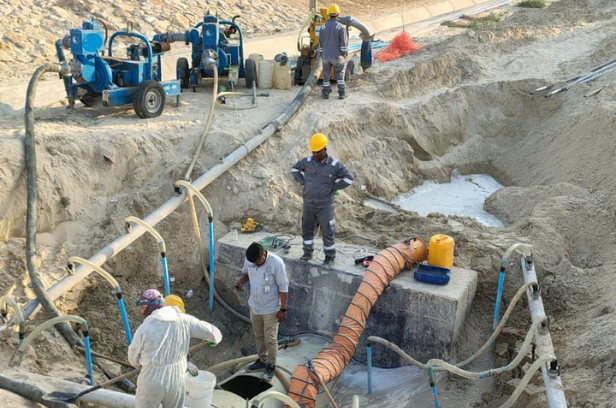
Excavation drawings show where construction will take place. Groundwater investigation helps establish how water may respond when the work begins. Both are important when planning foundations, utility trenches and underground structures.
Pumping tests for dewatering provide measured information about groundwater behaviour. The findings help designers assess the dewatering pumping arrangement, expected groundwater response and monitoring requirements before committing to the full installation.
For Saudi contractors, the practical question is what information the project needs and how testing will support the construction plan.
What Does a Groundwater Pumping Test Measure?
A pumping test involves extracting groundwater at measured rates and recording how water levels change over time. Measurements may be taken in the pumping well and strategically positioned observation wells.
The fall from the starting groundwater level is called drawdown. Its development during pumping, together with recovery afterwards, provides information for interpreting the groundwater system.
Equipment checks establish whether pumps and instruments operate correctly. An aquifer pumping test adds information about the water-bearing ground and its response to extraction. The test programme and interpretation should be directed by a suitably qualified groundwater specialist.
When Should Contractors Consider Testing?
Discuss testing with the project designer when existing investigations leave important questions about groundwater control unanswered. Examples include uncertainty over achievable drawdown, likely inflow or the interaction between pumping wells.
Sensitive surroundings, complex ground conditions or previous unexpected groundwater problems can also justify further investigation.
During planning, pumping tests for dewatering are most useful when their findings can still influence the system layout and construction programme. A specialist can decide whether the available information is sufficient or whether a targeted test or pilot trial would add value.
Common Pumping Test Types
| Test | What it involves | Main purpose |
| Step-drawdown test | Pumping through a planned sequence of different discharge rates | Examining the relationship between pumping rate and well drawdown |
| Constant-rate test | Maintaining a controlled pumping rate while recording groundwater response | Obtaining data for assessing aquifer behaviour and dewatering design |
| Recovery test | Monitoring water levels after the controlled pumping phase ends | Providing additional information to check and support the interpretation |
These tests examine different aspects of well and groundwater response. The appropriate sequence, rates and duration should be defined in the test plan.
Some projects also use a pilot trial involving a small group of wells or wellpoints. This can help assess a proposed arrangement under actual site conditions.
What Should Be Agreed Before Testing Starts?
A useful test begins with a clear question. For example, the designer may need to understand groundwater response at the proposed excavation or assess the performance of a trial well arrangement.
Confirm these planning items:
- Available information: Ground investigation reports, borehole logs, well records and excavation drawings.
- Test layout: Pumping and observation locations, depths and screened intervals.
- Equipment: Suitable pumps, flow measurement, water-level instruments and a reliable power supply.
- Discharge arrangements: Water storage, treatment where needed, the receiving point and applicable permissions.
- Responsibilities: Personnel for supervision, readings, equipment support and data interpretation.
Plan the discharge route to avoid unintended recharge near the test wells that could distort the measurements.
What Happens During the Test?
The field programme usually includes three connected stages:
- Baseline monitoring: Record groundwater levels before pumping and identify relevant background changes.
- Controlled pumping: Measure discharge and groundwater levels at the intervals specified in the test plan.
- Recovery monitoring: Continue recording groundwater levels after the planned pumping phase ends.
Maintain an event log alongside the readings. Record pump stoppages, changes in flow, nearby pumping and other events that could influence the results.
A consistent time record is essential. The person interpreting the test needs to know which water-level measurement corresponds to which pumping condition. water.usgs.gov
What Should the Pumping Test Report Include?
Request a report that connects the field records with the interpretation. A short statement that the pump operated successfully does not explain how the groundwater responded.
Useful deliverables include:
- A site plan showing pumping and observation locations.
- Relevant well-construction details and ground information.
- Time-stamped discharge and groundwater-level records.
- Graphs covering baseline, pumping and recovery periods.
- Notes on interruptions and external influences.
- The analysis method, assumptions and limitations.
- Interpreted groundwater parameters were supported by the data.
Ask the designer to explain what the results mean for the proposed excavation and whether further investigation is needed.
How Do Pumping Tests for Dewatering Inform System Design?
The findings can support decisions about well numbers, spacing, depth and the proposed groundwater-control arrangement. They should be considered alongside the excavation geometry, construction stages and required groundwater targets.
For example, water levels falling inside a pumping well do not automatically establish that the required drawdown has been achieved across the excavation. Observation data help the specialist assess the wider response.
Pump selection still requires a separate check of the required flow at the system’s total dynamic head. Discharge elevation, pipework and friction losses remain part of that calculation.
Treat the test as evidence for the design, with its coverage and limitations clearly recorded.
Discuss Your Groundwater-Control Requirements with Saeedcon
Saeedcon Dewatering Solutions provides wellpoint and deep well dewatering systems, groundwater monitoring support, and pumps for rental and purchase in Saudi Arabia. Saeedcon
If pumping tests for dewatering form part of your site investigation, share the interpreted findings with Saeedcon alongside the excavation drawings and geotechnical report. Include your site location, planned start date, expected duration and proposed discharge route.
Contact Saeedcon to discuss your groundwater-control requirements and request a quotation based on the available project information.
Frequently Added Questions
Is a pumping test required for every construction site?
The need should be determined by the project designer using the available ground investigation information, excavation requirements and groundwater risks. Further testing is useful where important design questions remain unresolved.
How long does a groundwater pumping test take?
There is no single duration suitable for every project. The specialist should define the pumping and recovery periods around the test objectives, ground response and quality of information required. Allow time for setup, baseline monitoring and interpretation as well.
Does testing replace the geotechnical investigation?
No. Pumping-test findings complement information about soil layers, groundwater conditions and the proposed construction. Both should be considered together when developing the groundwater-control design.
Can the test results determine the exact number of pumps?
They provide important design inputs, but the final arrangement also depends on excavation geometry, groundwater targets, well performance, discharge conditions and operational requirements. The designer should explain how these factors were assessed.
Pingback: Pipeline Trench Dewatering: Planning for Each Stage of Excavation - Local Business