
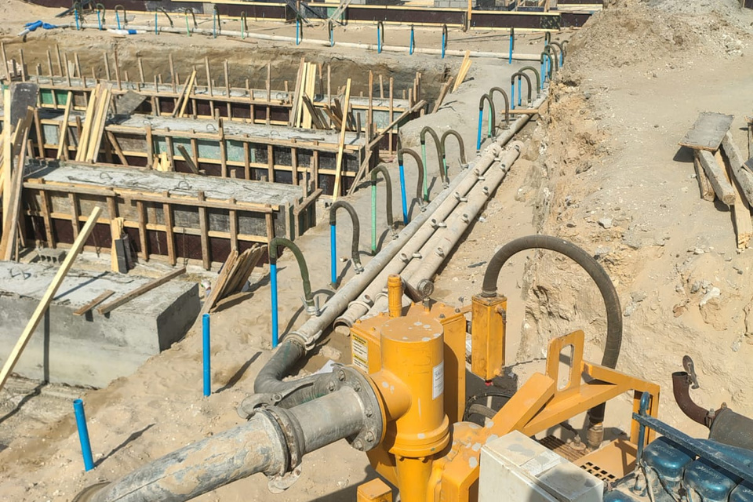
Submersible dewatering pumps are sealed pump-and-motor units that operate fully underwater. Because they sit in the water they are removing, they push it out rather than pulling it up, which lets them work from deep pits, shafts, and wells where surface pumps run out of suction. They are one of the most widely used pieces of equipment on construction sites in Saudi Arabia, from Riyadh basement excavations to coastal infrastructure in Jeddah and Jubail.
This guide explains how submersible dewatering pumps work, where they are the right choice, what their real limitations are, and the maintenance habits that determine whether they last a week or a whole project.
How Submersible Dewatering Pumps Work
A submersible pump combines an electric motor and a pump end in one sealed, watertight housing. When lowered into water and powered on:
- The motor turns the impeller, which spins water outward by centrifugal force.
- Water is pushed into the volute and up the discharge hose or pipe, so the pump lifts by pressure rather than suction.
- The surrounding water cools the motor, because the pump is in direct contact with it. Many designs add a cooling jacket so they can still run when partly exposed.
- Mechanical seals keep water out of the motor. Most dewatering models use a double seal with an oil-filled chamber between the pump and motor, which provides a second line of defense if the outer seal wears.
- Built-in protection monitors the pump. Common features include thermal overload sensors in the motor windings and moisture sensors in the seal chamber that trigger a warning or shutdown.
Why this matters on site: a surface pump is limited by how far it can pull water up, which in practice is about 7 to 8 m. A submersible has no suction lift limit because it is already in the water. It is limited instead by its discharge head, the pressure it can generate to push water up and out.
Key Components to Know
| Component | What It Does | Why It Matters |
| Motor | Drives the impeller; sealed and water-cooled | Overheating is the main cause of motor failure |
| Impeller | Moves the water; designs include vortex, channel, and semi-open | Determines how well the pump handles solids |
| Mechanical seals (usually double) | Keep water out of the motor | The most common failure point if worn or run dry |
| Power cable and entry | Supplies power through a sealed cable gland | Damaged cable insulation is a safety and failure risk |
| Strainer or base plate | Filters large debris at the intake | Prevents blockages and protects the impeller |
| Float switch or level control | Starts and stops the pump automatically | Reduces dry running and manual supervision |
| Thermal and moisture sensors | Detect overheating and seal leakage | Early warning before a costly motor failure |
Where Submersible Dewatering Pumps Are Used on Construction Sites
| Application | Why Submersibles Fit |
| Basement and foundation excavations | Deep pits where water sits well below ground level; quiet operation suits urban sites |
| Deep well dewatering systems | Placed down individually drilled wells to lower the water table across a wide area |
| Sump pits and drainage points | Small units in sumps with float switches for automatic operation |
| Shafts and tunnels | Compact and effective in confined, deep, and narrow spaces |
| Trench and pipeline works | Easy to move along the trench as work progresses |
| Flood response and emergency pumping | Fast to deploy; lower into flooded areas and start pumping |
| Utility and manhole bypass | Compact units fit inside manholes and chambers |
| Mining and quarry sumps | Heavy-duty and abrasion-resistant models handle slurry and silt |
| Wastewater and sludge transfer | Specialist vortex and channel impellers pass solids and fibrous material |
In Saudi Arabia, submersibles are especially common for high-rise and basement construction in Riyadh and Jeddah, deep well systems on sandy high-groundwater sites, and emergency flash flood pumping where speed matters.
Benefits of Submersible Dewatering Pumps
- No suction lift limitation. They pump from a depth that surface pumps cannot reach.
- No priming needed. Because they are flooded, they start immediately.
- Quiet operation. The water muffles noise, which helps on urban and noise-restricted sites.
- Compact and easy to position. They fit narrow pits, shafts, and wells.
- Self-cooling. The surrounding water carries heat away from the motor.
- Lower exposure to theft and site traffic. They sit in the pit rather than on the surface.
- Automatic operation. Paired with float switches, they run unattended and switch off when the level drops.
- Wide size range. From small portable units for sumps to large high-flow models for major excavations.
- No engine exhaust or fuel handling at the pit. This suits enclosed spaces, though a generator may still be needed for power.
Limitations and Operating Constraints
Being honest about limitations is what separates a good specification from a failed one.
| Limitation | What It Means in Practice | How to Manage It |
| Needs a power supply | No electricity means no pumping; remote sites need a generator | Plan generator capacity, fuel supply, and a backup |
| Harder to inspect and service | The pump must be lifted out to check it | Keep a spare unit on critical jobs for quick swaps |
| Dry-running risk | Running without water can overheat the motor and damage seals | Use float switches, level controls, and thermal protection |
| Abrasive wear in sandy water | Sand erodes impellers and seals quickly | Specify solids-handling or abrasion-resistant models |
| Clogging with debris | Rags, plastic, and large solids can block the intake | Use a strainer and keep the intake clear of debris |
| Corrosion in saline water | Coastal groundwater can attack unsuitable materials | Choose corrosion-resistant materials and appropriate seals |
| Limited by discharge head | Very high lift needs a more powerful pump or a staged arrangement | Size for total dynamic head, including friction losses |
| Cable vulnerability | Cable damage from handling or site traffic is a safety and failure risk | Lift by handle or chain, never by cable; protect cables on site |
| Minimum submergence requirement | Too little water over the pump can cause air entrainment and loss of performance | Follow the manufacturer’s minimum water level guidance |
| Electrical safety | Damaged insulation or poor earthing is hazardous in wet conditions | Use RCD protection, proper earthing, and qualified electricians |
How to Select the Right Submersible Dewatering Pump
Work through these questions before ordering or hiring:
- Required flow rate. How much water must you move per hour?
- Total dynamic head. Include vertical lift plus friction losses in the discharge line.
- Solids content. Is the water clean, silty, sandy, or debris-laden? Match the impeller design.
- Water chemistry. Is it saline, acidic, or otherwise aggressive? Check materials.
- Power availability. Grid or generator? Confirm voltage, phase, and capacity.
- Pit or well size. Does the pump physically fit with room for hose and cable?
- Duty pattern. Intermittent with float switches, or continuous 24/7?
- Backup plan. Is a standby unit available on site or on call?
Selecting by motor power alone is a common mistake. The pump curve, which shows flow against head, tells you what the dewatering pump will actually deliver at your site’s working point.
Maintenance: What Keeps Submersible Dewatering Pumps Running
Follow the manufacturer’s manual for intervals and specifications. As a general guide:
Before installation
- Inspect the cable, plug, and gland for cuts or damage.
- Check the impeller turns freely and the strainer is clean.
- Confirm the direction of rotation on three-phase pumps.
- Test the motor insulation resistance where recommended.
During operation
- Never lift or carry the pump by the power cable. Use the handle or a chain.
- Keep the pump upright and on a stable base, not buried in mud or silt. Raise it on a platform if the pit floor is silty.
- Keep the intake and strainer free of debris.
- Check that discharge flow and pressure are as expected. A drop usually means wear or blockage.
- Watch for unusual noise, vibration, or heat, and for tripped protection devices.
- Make sure float switches move freely and are not tangled with hoses or cables.
Periodic servicing
- Inspect and replace worn impellers, wear plates, and seals before they fail.
- Check oil in the seal chamber at the manufacturer’s interval. Milky or contaminated oil usually indicates a seal leak.
- Inspect the cable and cable entry for water ingress.
- Flush the pump with clean water after use in sandy, muddy, or saline conditions.
Storage between jobs
- Rinse, dry, and store upright in a clean place.
- Protect cables from kinks and crushing.
- Record running hours and service history for each unit.
Warning signs to act on immediately: tripping breakers, reduced flow, overheating, milky oil, unusual vibration, or any damage to the cable.
Submersible Dewatering Pumps in Saudi Arabia: Practical Notes
- Heat: Ambient temperatures and warm water can reduce cooling margins. Do not run pumps partly out of water unless they are designed for it.
- Sand and silt: Many Saudi sites have sandy groundwater. Specify solids-handling or abrasion-resistant models and plan for faster wear.
- Salinity: On coastal sites, ask about corrosion-resistant materials and seal types.
- Power logistics: On remote projects, generator sizing, fuel supply, and a standby set are part of the pump specification.
- Mobilization speed: Providers with depots in Riyadh, Jeddah, and the Eastern Province can often supply standard units within a day, which matters during flash floods or unexpected water strikes.
What Affects Submersible Dewatering Pump Price and Hire Cost
Instead of a generic figure that rarely matches a real site, these are the factors that move dewatering pump price and hire rates:
- Pump size, flow, and head capacity
- Solids-handling and corrosion-resistant specification
- Hire duration (daily, weekly, monthly)
- Support level, including delivery, installation, and monitoring
- Accessories such as hoses, cables, control panels, and generators
- Delivery distance and urgency
For an accurate figure, request a site-specific quote from a supplier in KSA based on your flow, head, and water conditions.
Final Word
Submersible dewatering pumps earn their place on site by solving the problems surface pumps can’t: depth, confined space, noise, and priming. They also demand respect for their limits: a reliable power supply, protection from dry running, the right impeller for the water, and a maintenance routine that catches seal and cable problems before they become failures.
Need submersible dewatering pumps for your project? Saeedcon supplies and supports submersible dewatering pumps for hire and sale across Riyadh, Jeddah, Dammam, Al Khobar, and Jubail. Contact our team for a same-day site consultation and quote.
Frequently Added Questions
What are submersible dewatering pumps?
Submersible dewatering pumps are sealed pump-and-motor units that operate fully underwater to remove groundwater and surface water from construction sites. They push water up and out rather than pulling it, so they are not limited by suction lift.
How do submersible dewatering pumps work?
An electric motor turns an impeller, which pushes water through the pump and up the discharge line. The surrounding water cools the motor, and mechanical seals keep water out of the motor housing.
What are the main benefits of submersible dewatering pumps?
They work from deep pits and wells, need no priming, run quietly, fit confined spaces, self-cool in water, and can run automatically with float switches.
What are the limitations of submersible dewatering pumps?
They need a power supply, are harder to inspect because they must be lifted out, risk damage if run dry, wear faster in sandy water unless specified for solids, and can be affected by saline water or cable damage.
Can submersible dewatering pumps run dry?
Generally no. Running without water can overheat the motor and damage seals. Use float switches or level controls, and choose models with thermal protection or a cooling jacket if partial exposure is expected.
Can submersible pumps handle sandy or muddy water?
Yes, if specified for it. Use solids-handling designs such as vortex or channel impellers and abrasion-resistant materials, and expect more frequent inspection of wear parts.
How deep can a submersible dewatering pump work?
There is no suction limit, so depth is limited by the pump’s discharge head and the well or pit dimensions. Deep well submersibles are used for much deeper applications than portable construction units.
How often should submersible pumps be serviced?
Follow the manufacturer’s schedule. Inspect seals, oil, impeller, and cable regularly, and more often in sandy, saline, or continuous-duty conditions. Keep a spare unit on critical sites.
Where can I find submersible dewatering pump hire in Saudi Arabia?
Dewatering pump hire providers in Riyadh, Jeddah, Dammam, Al Khobar, and Jubail typically stock submersible pumps. Confirm depot location, response time, and available solids-handling models when you enquire.
Submersible or surface dewatering pump: which should I choose?
Choose submersible for deep, confined, or fully flooded pits and quiet operation. Choose a surface pump for shallow open sites, remote locations without grid power, or where easy access is a priority.
Pingback: Dewatering Pump Maintenance: Daily Checklist | Saeedcon